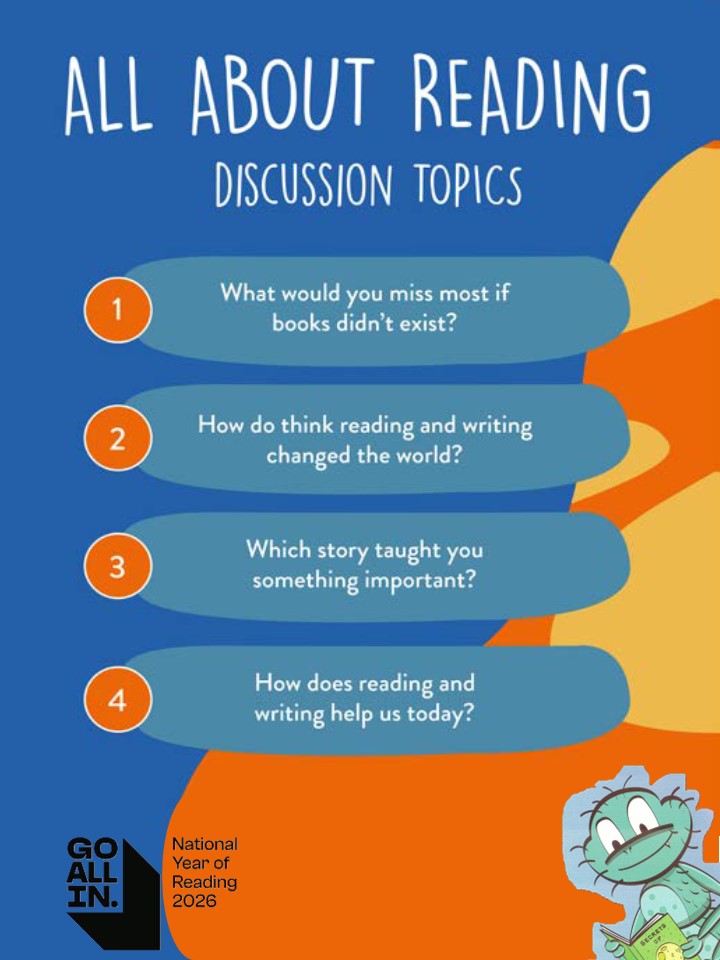
Reading is one of the greatest adventures a child can begin. It opens doors to imagination, knowledge, confidence, and creativity. So to inspire children to read more, explore more, and discover the joy of stories during this National Year of Reading— we’ve created these love to read discussion topics to help parents and teachers to help children discover the joy of stories—just like Spid the Spider.
📚 Love to Read Discussion Topics & Starter Answers
-
What would you miss most if books didn’t exist?
Imagine a world without books, imagine a time before books, or put yourself into the shoes of children who don’t have access to books.
Starter points:
- There would be no easily accessible means of:
- Relaxation
- Escape
- Inspiration
- Learning
- Reference
-
How do think writing and reading changed the world?
Writing and reading changed the world, helped people emerge from the dark ages
Did you know starter points:
- Around four thousand years ago, stories were shared only by speaking—nothing was written down.
- Knowledge could disappear if no one remembered it.
- People couldn’t learn about faraway places or ideas unless someone travelled there and told them.
- Writing allowed people to store ideas so they wouldn’t be forgotten.
- Books helped scientists, explorers, and inventors share discoveries.
- Reading made it possible for people to learn without a teacher standing beside them.
- Libraries give everyone free access to books and knowledge. They’re places to explore, discover, and learn. The first library in the world dates from 2500 BCE/BC. Located in present day Syria, the Ebla royal civic archive housed clay tablets which functioned as early archives. Because the palace was destroyed by a massive fire, the intense heat accidentally baked and perfectly preserved the thousands of clay tablets stored on its wooden shelves. It’s discovery profoundly changed our understanding of the people of that time.
- The invention of printing presses (Thomas Caxton, in the 1400s) meant books could be made quickly and cheaply—so knowledge spread everywhere.
-
Which story taught you something important?
Stories matter, they take us different places, encourage us to try new things
Starter points:
- Stories help us understand feelings, friendships, bravery, kindness.
- They let us visit magical worlds, different cultures, travel through time, and gain new perspectives.
- They preserve voices from the past—kings, explorers, scientists, ordinary people.
- Books introduce you to careers, adventures, inventions, and possibilities.
- They show you what humans have achieved—and what you might achieve too.
- Spid the Spider books allow us to travel to ancient Egypt, the Moon, to spend the night in a haunted forest, open a bakery and join in a thrilling game of cricket.
-
How does reading help us today?
Today we read on paper, screens, tablets, phones, and audiobooks. Stories are everywhere—games, apps, websites, comics. Reading is a super-power.
Benefits of reading starter points:
- Reading builds imagination, vocabulary, and confidence.
- Reading helps you learn new skills—cooking, coding, crafting, sports.
- It helps with school subjects—science, maths, history, everything.
- It improves focus and helps children express themselves clearly.
- Reading for fun makes your brain stronger, just like exercise makes your body stronger.
- When you read about characters facing challenges, you learn to understand feelings.
- Stories help you imagine what life is like for people who are different from you.
- This makes you kinder and more thoughtful.
- Reading skills also help you navigate the digital world safely and confidently.
- It helps you understand instructions, rules, and how things work.
- It gives you independence: you can find answers yourself.
-
How does reading aloud or with other people help you?
Starter points:
- Shared reading builds connection between people, adults and children.
- It helps us hear and say new words.
- It is a means to ask questions and learn from feedback.
- It shows that reading is enjoyable, not just schoolwork.
-
How does writing help you today?
Benefits of writing starter points:
- Writing helps you remember and share ideas, feelings, and creativity.
- It’s used everywhere: texting, homework, games, instructions, signs.
- Writing helps you organise your thoughts and solve problems.
-
What story would you write if you could publish a book?
Stories start with ideas; sometimes mirrors or windows on the world
Starter points:
- Every book starts with a spark: a question, a character, a problem.
- Writers plan, draft, edit, rewrite, and polish.
- A mirror book or story reflects your own life—your family, your school, your feelings.
- A window book or story shows you someone else’s life—different cultures, challenges, adventures.
- Both help you understand yourself and others.
- Illustrators bring characters to life visually.
- Printing and publishing share the story with the world.
-
What adventure should Spid have next?
Starter points:
- How does Spid learn new things?
- What problems does Spid solve using curiosity or knowledge?
- What might Spid discover if he read a book about dinosaurs or inventions?
- Write the first two sentences of a new Spid the Spider story and then share it with your teacher or mum and dad. You can also send it to Spid via this website. He loves ideas for new things to do!
How Motivated is Your Child to Learn to Read?
Use our pre-reading motivation assessment to find out how motivated your child is to read. Then use our post-reading motivation assessment to monitor any change after discussing the benefits of reading and reading a few books.
Download our love to read discussion topics and answers